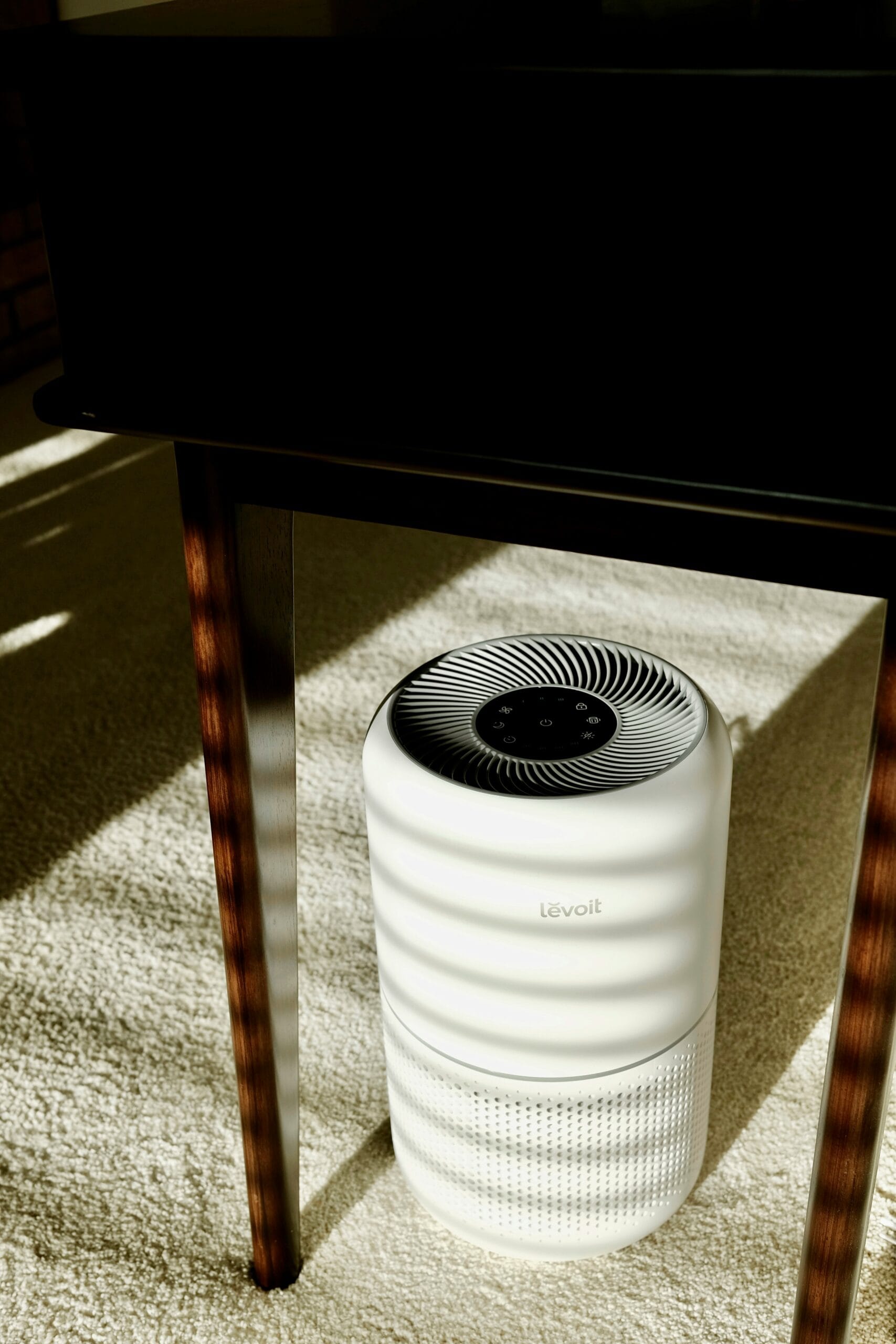
Do NOT get me started on “AI” air purifiers or whatever the latest branding is that they’re slapping on products. I see AI health monitors, AI air purifiers, AI… phone chargers. (Yes, the phone chargers can have smart technology in them to stop charging when your phone is full but that is NOT AI!!!). So just to sum it up, I’m tired of AI getting slapped on every product label because it helps them sell more even when it’s not accurate. Buzz word, buzz word, buzz word.
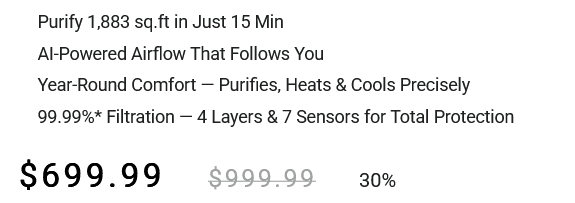
$700 for an air purifier that follows your movement. A) That’s not necessary. B) That’s not what AI is (usually).
Quick summary
I’m recommending air purifiers that actually clean air without relying on gimmicky features. This is based on a mix of research (reviews, forums, listings), my own air purifier setup, and limited hands-on testing.
Quick picks
- Best basic small-room pick: Levoit Core Mini-P
- Best basic medium-room pick: Levoit Core 300-P
- Best “auto/sensor” pick: the famous “iPod Shuffle” style unit below
- Best big open-space pick: Blueair (massive airflow)
- Best heavy-duty “serious allergies/wildfire” pick: IQAir HealthPro series
How I’m thinking about sizing (quick rules)
- If a purifier claims it covers your whole house, I still recommend splitting that up into multiple units. Airflow doesn’t magically move through floors, walls, and closed doors.
- One solid unit per a few rooms (or at least one per floor) is usually smarter than one huge expensive unit.
- Filter availability matters. Replacement filters are half the battle.
- If your unit has an ionizer, I recommend turning it off if you’re worried about ozone. Kinda has a mixed rep.
I am a sucker for a good air purifier. No, I haven’t tested my air quality – so this isn’t a “verified review” or whatever I’m calling them nowadays. In the future I WILL setup a test lab with multiple air purifiers, air quality monitors, and different air pollutants. I promise I will try to make that happen. But for now, this is based on my research of what feels like a billion blog posts, Reddit threads, Amazon reviews, my own air purifier setup, and basically anything that didn’t have stupid claims. I will try my best to condense all this information for you.
I believe that there are “levels” to this whole air purifier thing. You really have to be a connoisseur. Joking. But most people just want something pretty basic that cleans their air, doesn’t have over the top features, and works in either one room or their whole house. These two options below are going to be your best basic air purifiers that have different sizes based on how much square footage you need to cover. Even if an air purifier says that it will filter 3,000 square feet, I still recommend splitting that up into 3 air purifiers that each cover 1,000 square feet or a combination of the sorts. Based on research, my somewhat limited testing, and just basic airflow rules, an air purifier on the first floor of the house isn’t going to purify the second floor that well, it just won’t reach. Add in closed doors and walls, and it’s just stupid to drop $400 on a huge air purifier. So I would recommend one for every few rooms, maybe one per floor if you get one that’s big enough.
The Most Basic Picks
Levoit Core Mini-P (small rooms)
This Levoit Core Mini-P is as basic as you can get. This is what I would recommend to everyone for a dorm room, single bedroom, or any room that isn’t really a large shared space. This is perfect for personal use. It doesn’t have crazy smartphone features, air quality detection, or night light but it absolutely cleans your air. Levoit is one of the main brands in air purification, and one of the top selling ones (if not first). I feel way better recommending you this instead of “FULMINARE” or whatever random brand was below this listing on Amazon. The one feature that this air purifier has, that a lot don’t seem to have is a scent pad. You can put whatever essential oil or scent oil on the included pad, and have the scent come out of the airflow. It’s not the strongest, but it’s definitely noticeable. For this purifier, and any name brand purifier, I really recommend buying the official filters. I know the off-brand 2-pack filters look the same, but there is a noticeable difference when testing with an air quality meter (and the amount of dog hair in my house!) Off-brand filters can vary a lot, and may not meet true HEPA performance the same way the brand-name filter does.
- Best for: dorm rooms, bedrooms, personal spaces
- Key points: simple, no app/sensors, scent pad feature
- Filter note: I recommend official filters for more consistent performance
Levoit Core 300-P (medium rooms)
This makes the next air purifier in this basic section the same exact model, but bigger. This is the Core 300-P (I think the P stands for pet in these, as they usually have some sort of pet dandruff/ hair filtering). There isn’t much more to say about this one as it’s almost identical to the last one but bigger to filter more room area. This is one that I would recommend for every floor (instead of one big one for the whole house). This one has a few more features like a sleep mode that quiets down the fan. And yes, I have this one too. They do have Levoit Core models that go up to 350, 400, and 600 but I have limited testing knowledge about these and they have smart features and other stuff that wouldn’t fit this category (hence the S in Core 400S-P, Core 600S-P…).
- Best for: bedrooms, offices, small living rooms, one-per-floor setups
- Key points: same idea as Mini-P but bigger, sleep mode
- Sizing note: I’d rather run multiple of these than one “whole house” unit
Auto/sensor picks (more data, still normal)
Coway AP-1512HH Mighty (the famous “iPod Shuffle” unit)
These next two options are for when you want a little more data without paying for a robot that follows you around the room. These have sensors to tell you if your air is actually dirty, which is nice if you want to see a light change colors when you’re cooking bacon or brushing a shedding dog. They have apps, but you can mostly just set them to “auto” and forget they exist.
This is probably the most famous air purifier on the internet for a reason. The real name is the Coway AP-1512HH Mighty, but it looks like an oversized iPod Shuffle from 2005, and it is a workhorse. It has a four-stage filtration system and a built-in ionizer that you can actually turn off (which I recommend doing if you’re worried about ozone). The best part about this one is the “Eco Mode.” When the sensor decides your air is clean for 30 minutes, it just shuts the fan off to save power. It’s a great choice for a living room or a large master bedroom where you want the machine to think for itself a little bit without being annoying about it. As of writing, it’s $155 which actually seems like a great price for what you get, although I haven’t technically done thorough testing with this unit.
- Best for: living rooms, master bedrooms, “set it and forget it”
- Key points: eco mode, auto behavior, ionizer can be turned off (Coway AP-1512HH Mighty)
- Watch out for: I haven’t done thorough testing with this exact unit
Levoit Core “S” series (app + sensor)
I know I just talked about Levoit, but their “S” series is the step up when you want the app connectivity. This one covers significantly more square footage than the 300-P and includes a laser air quality sensor. The “Smart” part here just means you can look at your phone to see the PM2.5 levels in the room. It’s circular, so it pulls in air from 360 degrees, which makes placement a lot easier since you don’t have to worry about which way the intake is facing. It’s quiet, it’s effective, and the replacement filters are easy to find, which is half the battle with these things. And yes, if you were wondering, Levoit makes other purifiers outside of the “Core” line. For some reason, nothing outside of the Core brand popped up during my research. But they do have other huge units that may be worth a look?
- Best for: people who want app + PM2.5 readouts without overthinking it
- Key points: laser sensor, 360 intake, easy placement
- Filter note: replacement filters being easy to find is a huge plus
Heavy-duty picks (allergies, wildfire smoke, big spaces)
Blueair (high airflow for open spaces)
If you have serious allergies or you live somewhere where wildfire smoke is a regular guest in your house, the basic stuff might not cut it. These are the “buy it once and keep it for a decade” options. They are heavy, they are expensive, and they focus entirely on the quality of the filter media rather than how many cool buttons are on the display. Which is why I stressed buying legit, 1st party filters earlier!
Blueair uses a different type of technology that charges the particles before they hit the filter, which theoretically lets them use a less dense filter to get better airflow. Do what you what with this information. All I know is that it’s a great purifier, and has been tested through the toughest conditions from 3rd party reviews (not marketing crap on their website). This thing moves a massive amount of air. If you have a high ceiling or an open-concept kitchen and living area, this is the one that can actually handle the volume. It has a fabric pre-filter on the outside that catches the big clumps of dust and hair, and you can get different colors to match your furniture. Also it’s a “chill” $350, so this is quite an investment for an air purifier. You can however use HSA/FSA if buying directly through their site!
- Best for: open concept rooms, high ceilings, big shared spaces
- Key points: moves a ton of air, pre-filter catches hair/dust, multiple colors
- Watch out for: it’s an investment
<div class=”iframely-embed“><div class=”iframely-responsive” style=”height: 140px; padding-bottom: 0;“><a href=”https://www.amazon.com/BLUEAIR-Purifiers-HEPASilent-Allergies-Purifier/dp/B0BN2MGV5H” data-iframely-url=”https://iframely.net/TfI5yqM2?card=small&theme=dark“></a></div></div><script async src=”https://iframely.net/embed.js“></script>
IQAir HealthPro (hospital-looking tower)
This one I genuinely can’t say much on. It looks like a gray hospital tower and it’s built in Switzerland. I think it literally is, hospital grade. his is what you get if you are genuinely concerned about mold spores, bacteria, or heavy VOCs. I mean, you gotta be living in some crazy apocalyptic polluted city for this, or just have crazy allergies.
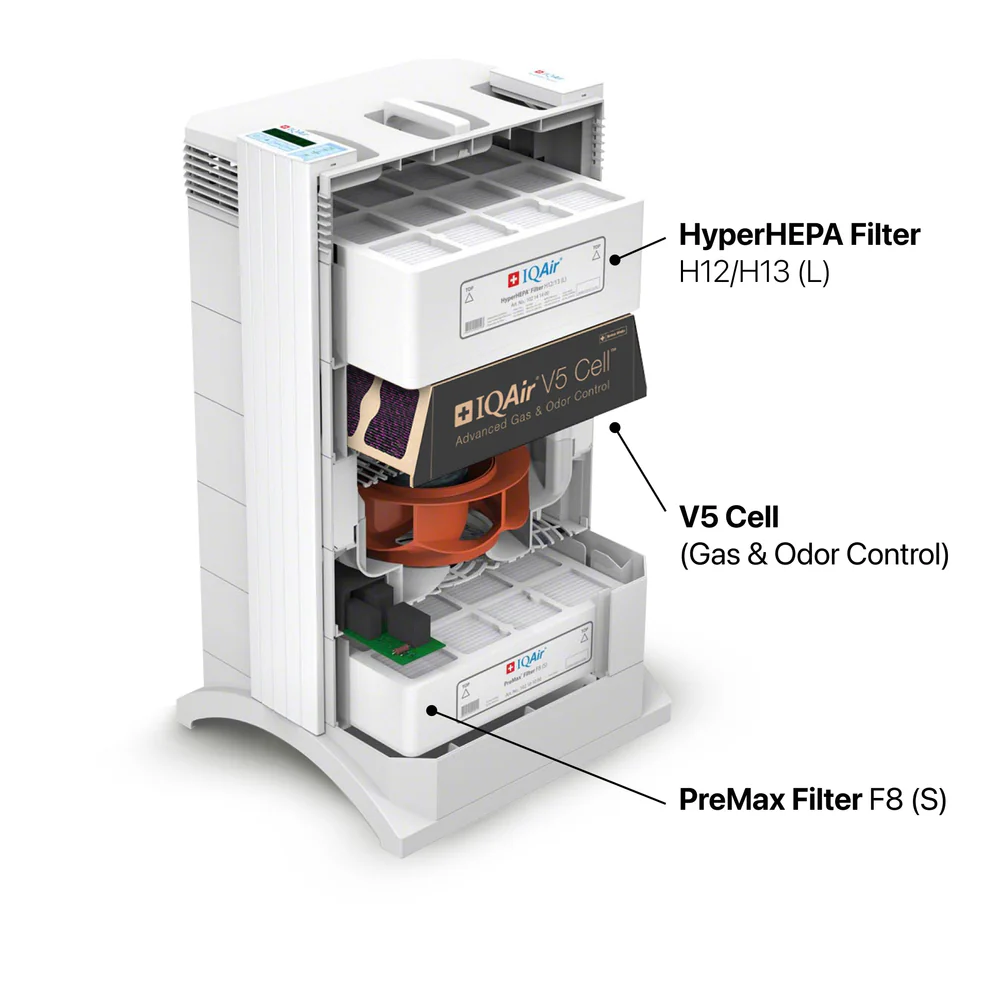
- Best for: serious allergies, smoke events, “I want the heavy-duty thing”
- Key points: built like a tank, filter-first approach
- Watch out for: I can’t personally say much on it yet
Frequently Asked Questions
Should I buy one huge purifier for my whole house?
I wouldn’t. Multiple units usually make more sense because floors, walls, and doors kill airflow.
Do I need “AI” features (or some other stated feature not mentioned)?
No. Sensors and auto mode can be useful, but “AI” is mostly marketing. App control is really up to you, and if you want another “thing” connected to your home WI-FI. My philosophy is that things like toasters, fridges, and washers don’t need an app, smart features, or WI-FI connectivity as it just causes more data farming and really doesn’t give me that “reputable product” feel. Do what you want with this information to apply it to air purifiers.
Should I use off-brand filters?
They can work, but performance varies. If you’re buying a name brand purifier because you care about clean air, I’d lean toward the official filters for more consistent results. I’ve done both but unfortunately haven’t tested the difference with an air quality meter in closed testing conditions.